Cooktop & Rangetop Repair
Why one burner clicks forever and never lights
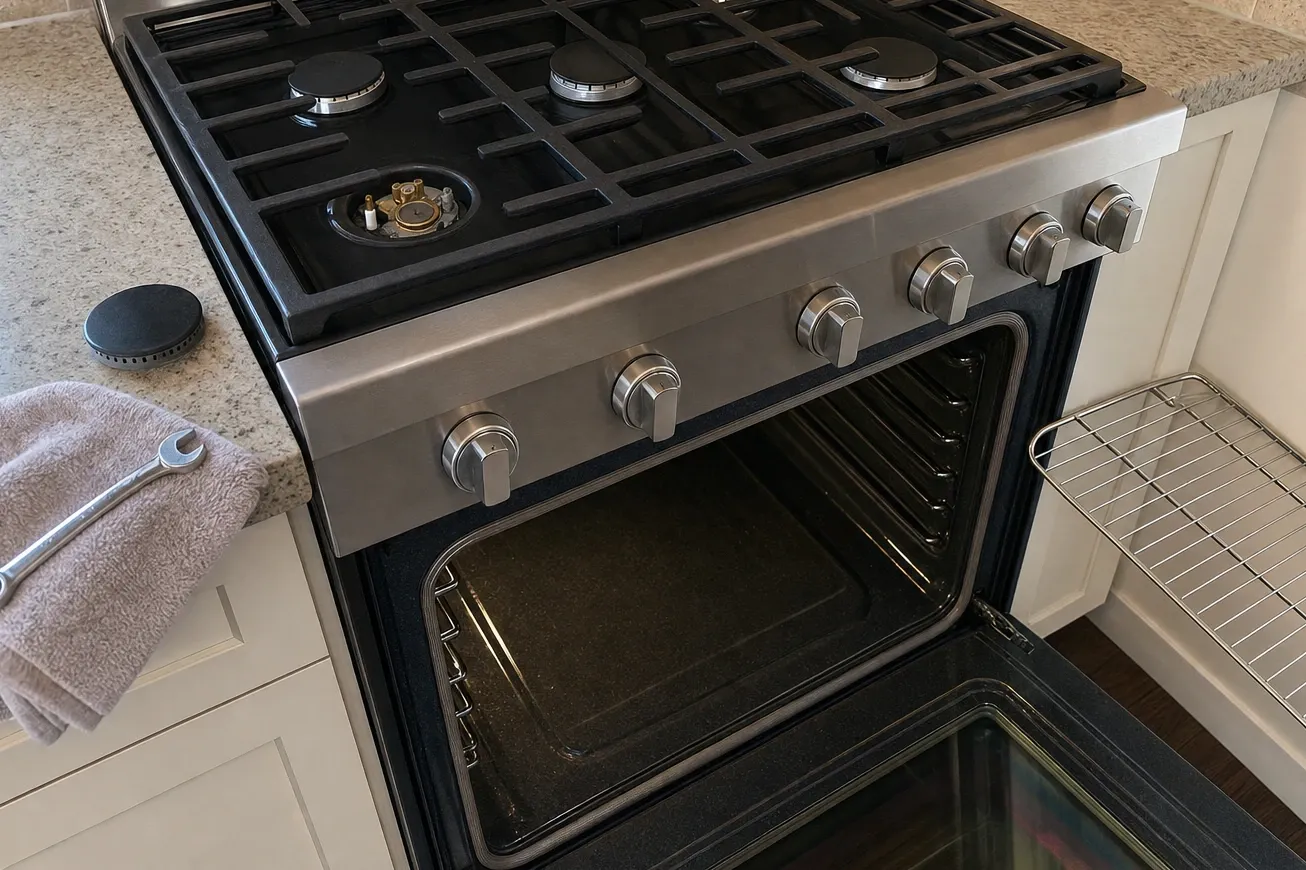
The endless tick of one burner that will not take a flame is the call that arrives most often from a professional gas top, and it is also the one most reliably misdiagnosed before anybody has looked at it. The instinct is to blame the spark module, because the ticking is the loudest part of the problem. It is almost never the problem. On a sealed-burner top a single module drives every electrode from one circuit, so a module that had genuinely failed would leave you with a silent cooktop and four dead burners — not one burner ticking away while its neighbours light on the first try.
What that pattern is telling you instead is that one burner is being asked to light and is not managing it. There are four reasons for that, they can be worked through in about two minutes with the gas off, and three of them cost nothing to fix.
Start with the cap, because it is usually the cap
Lift the grate and lift the burner cap off. Look at where it sits. The cap has to drop flat onto the burner head with the notch or locating pin seated, and the whole assembly has to sit flat in its well. If the cap is a millimetre proud, or rotated a few degrees off its seat, the flame ports no longer line up with the electrode and the spark has nothing to ignite.
This happens constantly after a clean. Caps get lifted off four at a time, washed, and put back in a hurry — and they are not interchangeable between burner sizes on most tops, even when they look it. A cap from the small burner sitting on the large one will click forever.
While the cap is off, look at the burner head itself. Boil-overs push sugar and starch down into the ports, and a ring of blocked ports on the side nearest the electrode will stop ignition even though the other three-quarters of the burner is perfectly clear. A stiff brush and a straightened paperclip clear them. Do not drill them out, and do not use a wire brush on the electrode.
Then look at the electrode, and specifically at its ceramic
The electrode is the small ceramic post standing in the burner well with a wire running to it. Two things go wrong with it and both are visible.
The first is water. A spill that runs into the well, or a cap that was put back wet, leaves the ceramic damp — and a damp ceramic bleeds the spark to the burner body instead of jumping the gap. This is why a burner that would not light on Sunday night lights perfectly on Monday morning. If the well is wet, dry it and try again before you conclude anything at all.
The second is a hairline crack in the ceramic, usually right at the base where it meets the metal. A cracked ceramic does exactly what a wet one does — it earths the spark somewhere other than the gap — except it does not dry out. In a dark kitchen you can sometimes see the spark jumping to the side of the post rather than across to the burner. That is a part, and it is a small one.
Check the gap, then check whether it is a gas problem at all
The spark has to jump from the electrode tip to the edge of the burner head, and that gap wants to be roughly the thickness of a stiff business card. Grates get dropped, pans get shoved, and an electrode that has been knocked back sits too far away to arc reliably. It can be eased back with fingers or fine pliers, gently, with the power off at the breaker — and if the ceramic is cracked, do not bend anything, because it will snap.
If the cap is seated, the ports are clear, the ceramic is dry and intact and the gap looks right, stop and try the match test. Hold a lit match at the burner and turn the valve on. If it lights and burns a tight blue flame, everything on the gas side is fine and you have narrowed the fault to the spark circuit — usually that electrode, occasionally its lead.
If it will not light off a match, or the flame that comes up is small, yellow and lazy, the electrode was never the problem. That is gas delivery: the valve, the orifice, or the pressure reaching the appliance. This matters more than it sounds on the northwest side, where a lot of professional ranges were fitted during a rehab and the gas run reaching them is older than they are. A range that is being starved will light three burners and refuse the fourth, and no amount of electrode work will change it.
What is worth calling somebody for
Three of the four checks above are yours. Clear the ports, seat the cap, dry the well, ease the gap. If the burner lights afterwards, that was the whole job.
Where it becomes a visit is when the match test says the gas side is wrong, when nothing sparks on any burner, when you can smell gas with everything turned off, or when the ceramic is cracked and you would rather not be the person removing a burner assembly from a live gas manifold. Any of those is a job for someone with a manometer, because the honest answer about pressure cannot be reached by looking.
Follow-ups
- Is it safe to keep using the other burners while one clicks?
- The clicking itself is not dangerous, but keep the failing burner turned off while you sort it. Gas is leaving the port every second the valve is open and not lighting, and on most sealed-burner tops the spark module fires every electrode at once, so leaving it running fills the surrounding burner wells with unburnt gas as well. Turn it off, let the top clear for a minute, and work through the checks below.
- Why do all the electrodes spark when I only turned on one burner?
- That is normal on a sealed-burner top. One module drives every electrode from a single circuit, so turning any burner to LITE sparks all of them. It is also why a single cracked or wet electrode makes the whole array carry on clicking after another burner has already lit — the module keeps firing because one switch is still telling it to.
- The burner lights if I hold a match to it. Does that narrow anything down?
- It narrows it a lot. If it lights and burns cleanly off a match, the gas path is fine — the valve, the orifice and the burner ports are all doing their job, and the fault is in the spark side or in the cap position. If it still will not light off a match, or the flame is small and lazy, the problem is gas delivery and the electrode is innocent.